 BUILDING EXPANSION JOINTS
Wall-to-Wall · Seismic Cover
Dseal JointShield
JointShield is a wall-to-wall seismic cover system with an integral water barrier, delivering shield-like protection for large multi-directional movement joints with a vertical variant also available.
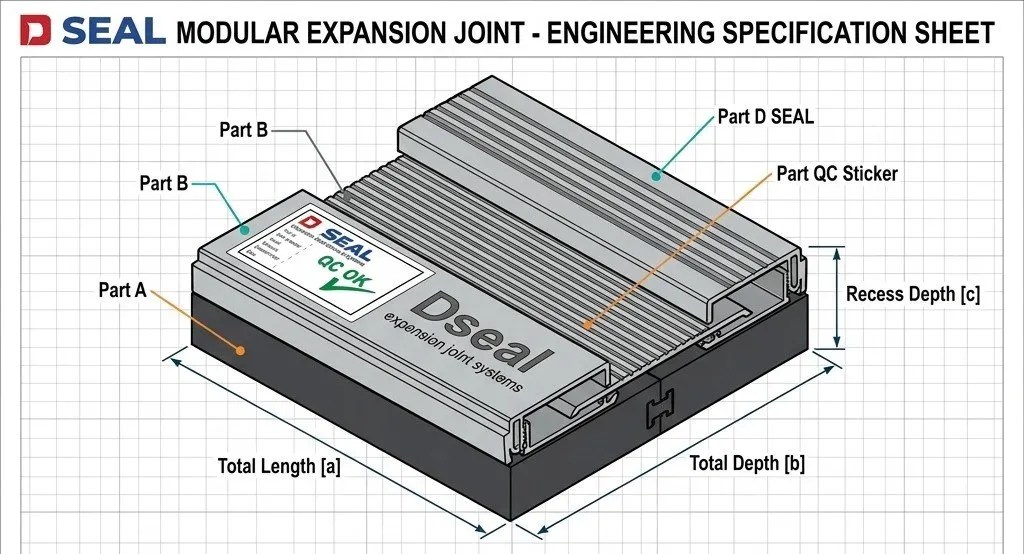
Click image to zoom · 2D blueprint, 3D render & product photo
JointShield is a wall-to-wall seismic cover system that combines a robust cover with an integral water barrier, shielding large movement joints in seismically active structures. It is used on wall-to-wall conditions in buildings that must accommodate substantial multi-directional movement, with a vertical variant, JointShield-V, available.
JointShield accommodates multi-directional seismic movement while the integral water barrier helps keep moisture from passing through the joint. The system is engineered for the large displacements expected during seismic events on major structures.
Key Benefits
- Integral water barrier helps keep moisture out of the joint
- Accommodates large multi-directional seismic movement
- Shield-like cover protects walls during seismic events
- Vertical variant (JointShield-V) suits vertical conditions
- Engineered for major structures in seismic zones
- Manufactured and supported in India by Dseal
Applications
- Buildings in seismic zones with large wall joints
- Hospitals and critical facilities requiring continuity
- Airports, transit hubs and large public buildings
- High-rise towers with significant seismic movement
- Institutional campuses with linked seismic blocks
- Structures requiring water-resistant wall joints
Features & Construction
- Wall-to-wall seismic cover system
- Integral water barrier built into the assembly
- Multi-directional seismic movement capability
- JointShield-V vertical variant available
- Robust cover engineered for large displacements
Technical Specifications
| Type | Wall-to-wall seismic cover |
|---|---|
| Water barrier | Integral |
| Movement | Multi-directional (seismic) |
Installation Guide
- Confirm the seismic movement range and joint width
- Clean both wall faces and verify the substrate is sound
- Install the integral water barrier across the joint
- Fix the base or anchor members to each wall side
- Set the seismic cover over the joint to allow free movement
- For vertical runs, install the JointShield-V variant as specified
- Test the run for unrestricted movement and barrier continuity
Maintenance & Care
JointShield benefits from periodic inspection, particularly after seismic activity. Check the cover, fixings and the integral water barrier for damage or displacement, and clear any debris that could restrict the large movement the system is designed to absorb.
Confirm the water barrier remains continuous and unbroken so moisture protection is maintained. If the barrier or cover is compromised after a seismic event, contact Dseal (Dseal Solutions Private Limited) for matching JointShield or JointShield-V replacement components.
FAQs
JointShield — Frequently Asked Questions
What is JointShield?
JointShield is a wall-to-wall seismic cover system from Dseal that combines a protective cover with an integral water barrier to shield large movement joints in seismic structures.
What movement does JointShield accommodate?
JointShield accommodates large multi-directional movement, making it suited to the substantial displacements that occur during seismic events.
What is the integral water barrier for?
The integral water barrier helps prevent moisture from passing through the joint, protecting the structure while the cover handles seismic movement.
Is there a vertical version of JointShield?
Yes. A vertical variant, JointShield-V, is available for wall-to-wall conditions that run vertically.
Where is JointShield used?
JointShield is used on wall-to-wall joints in seismic-zone buildings such as hospitals, airports and high-rise towers that require large movement capability and water resistance.
Can JointShield handle seismic events?
Yes. JointShield is engineered specifically for seismic conditions, absorbing large multi-directional movement to protect the wall joint.
What material is JointShield made from?
JointShield uses durable cover components with an integral water barrier; Dseal can confirm the specific materials and aluminium grades for your specification.
How do I maintain JointShield?
Inspect the cover, fixings and water barrier periodically and especially after seismic activity, clear debris from the joint, and confirm the barrier remains continuous.
What standards apply to JointShield?
Dseal manufactures JointShield under ISO 9001:2015, ISO 14001:2015 and ISO 45001:2018 certified processes, with aluminium components to ASTM B221-02 / ASTM 6063 where used.
How is JointShield different from ProGuard?
JointShield is a seismic wall-to-wall cover with an integral water barrier for large multi-directional movement, while ProGuard is a general SMN-series wall-to-wall cover for compound buildings.
How does JointShield compare to SeismoMax?
JointShield is a wall-to-wall seismic cover with a water barrier, whereas SeismoMax is a broader seismic joint system engineered for large multi-directional movements with specialised seismic components.
Are custom sizes available for JointShield?
Yes. Dseal supplies JointShield and JointShield-V configured to your joint width and seismic movement range; contact Dseal Solutions Private Limited with your project details.
Does JointShield provide a fire or acoustic barrier?
JointShield includes an integral water barrier; where fire or acoustic separation is also required, Dseal can recommend compatible barrier accessories for the seismic joint.
Who manufactures JointShield?
JointShield is designed and made in India by Dseal Solutions Private Limited under the Dseal brand.
Where can I buy JointShield in India?
JointShield is available directly from Dseal (Dseal Solutions Private Limited) across India. Call +91 93109 97953 to discuss your seismic joint requirements.
When should I choose JointShield-V?
Choose JointShield-V when the wall-to-wall seismic joint runs vertically and needs the same shield-like protection and water barrier as the standard JointShield.
Explore More
Related Products

ProGuard
Wall-to-wall expansion joint (SMN series) designed to absorb the structural movements of large or compound buildings.
View Product →
AeroGuard
Architectural wall expansion joint cover combining clean aesthetics with dependable movement accommodation.
View Product →
Aerostar
Wall-to-wall expansion joint cover with a lock profile, providing secure retention and a clean architectural line.
View Product →
ClampJoint
Wall-to-wall clip-joint cover system, including corner configurations, for secure clamped retention of the joint cover.
View Product →
Corner Joint System
Corner expansion joint profile for wall-to-wall corner conditions, with a clip-retained cover for a clean inside or outside corner.
View Product →
SeismoMax
Seismic expansion joint system engineered to absorb large, multi-directional movements in earthquake-prone structures.
View Product →